Gerrymandering, by request of the President
Trump wants the Texas legislature to save him from Democrats
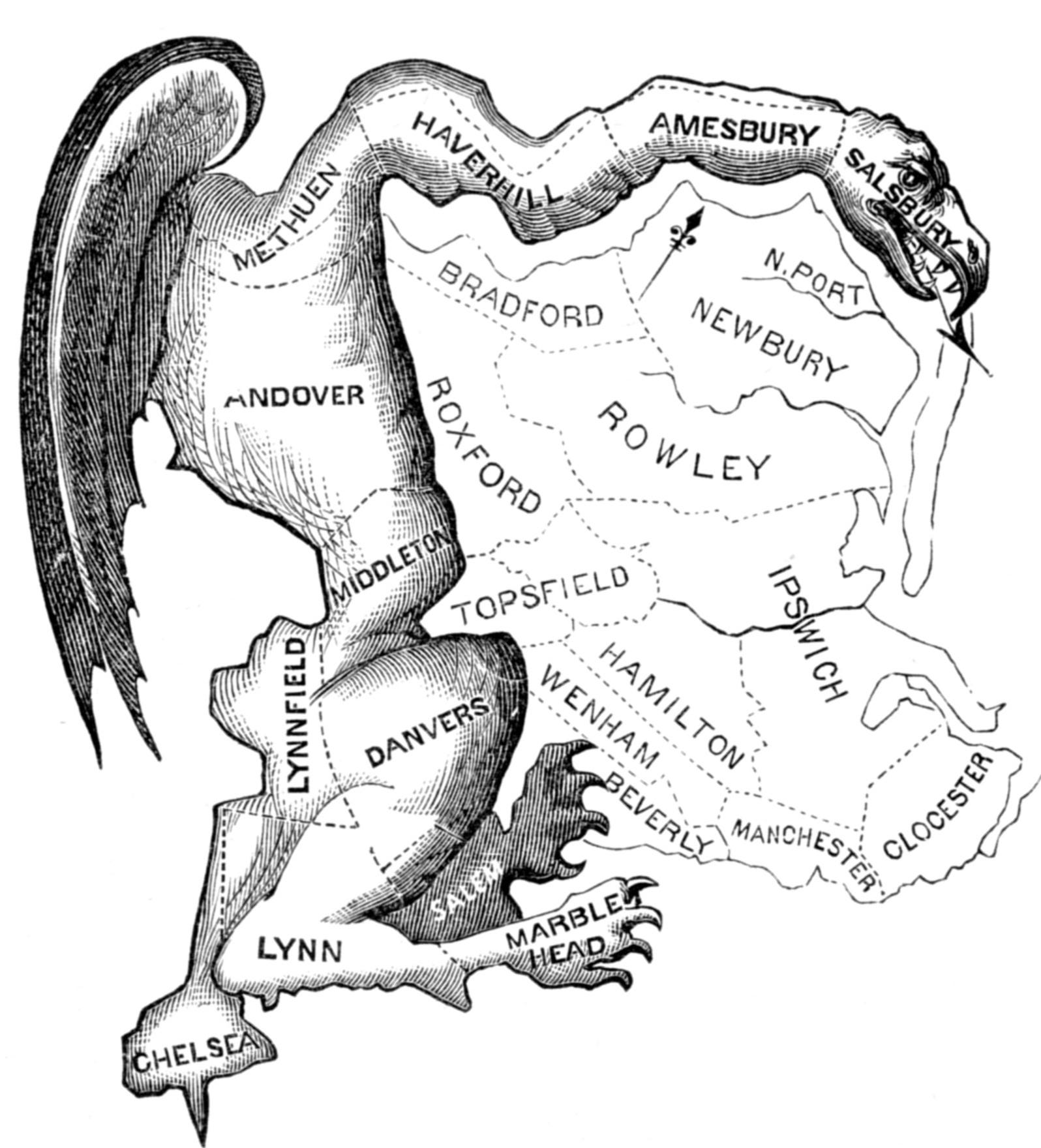
Image: A political cartoon from 1812, drawn by Elkanah Tisdale. It lampoons an oddly-shaped district drawn to favor Massachusetts Governor Elbridge Gerry’s Democratic-Republican party, giving rise to the term “gerrymander”. It is perhaps unfair that Gerry, generally highly respected by his revolutionary compatriots, and whose beliefs shifted between parties, became most well known for this partisan antidemocratic practice.
The Republican-controlled Texas state legislature is redrawing the congressional district map that will be used to elect the Texas delegation to the U.S. House of Representatives in 2028.
They are not doing this as part of a normal redistricting cycle, to account for fluctuations in the spatial distribution of the Texas population. That redistricting happened after the decennial 2020 U.S. Census data had been collected. The next decennial Census—which will deliver updated population estimates—is scheduled for 2030.
They are not redrawing the map because the state legislature has changed parties since the last map was drawn—a plausible reason to redistrict mid-cycle. No, Texas Republicans fully controlled the state legislature in 2020 and already have a map favorable to their party.
The Republicans in the Texas state legislature are redoing their congressional district map for one reason: President Donald J. Trump wants them to. Trump has made it clear he wants multiple additional seats, even up to 5 from Texas alone. It’s risky for the Texas Republicans currently in office; they’ll have to dilute their own seats as they carefully redistribute projected Republican voters to new districts. Of course, Trump doesn’t particularly care about the antidemocratic protections some random state-level Republican has built around keeping their own seat.
Trump is concerned that Republicans will lose their majority in the U.S. House in 2028—a valid concern given their already tight margin (219 R to 212 D, 4 vacant). A House controlled by Democrats would not only make Trump’s agenda more difficult to implement. Democrats would no doubt use their new power to begin broad-scale investigations of Trump, his associates, and members of his administration. The chairs of House committees can issue subpoenas, and Democratic chairs would assuredly use that ability to shine some daylight on Trump’s corruption and usurpation of power.
Oddly enough, the fact that Trump’s attempt to bully his way into more House seats is so nakedly partisan makes it more resistant to legal challenges. In a 5-4 decision written by Chief Justice John Roberts in Rucho v. Common Cause (2019), the U.S. Supreme Court decided that challenges to partisan redistricting are not justiciable, meaning that the Court considers them purely political matters and thus outside judicial authority. According to the five court members who signed the decision, it is simply up to the other branches of government to work it out.
In a typically fiery dissent, Justice Elena Kagan described what she called the “grisly” results of partisan gerrymandering and then asked, “Is that how American democracy is supposed to work? I have yet to meet the person who thinks so.”
Unfair district maps can impact statewide races. When an alternative party sees no way to win a district, they devote fewer resources to the race, sometimes not even running candidates. This means that voters in that district never hear typical election-year debates over ideas and policies; there is no alternate candidate to combat the predetermined winner, leaving the party in power free to spread hyper political rhetoric, hyperbole, and even lies.
This is arguably how a heavily gerrymandered state like Ohio shifted to become an overwhelming red state despite a long reputation as the ultimate “purple” bellwether in statewide races. “As Ohio goes so goes the nation,” we used to say.
After the 2010 Census, the Republican Party mobilized to gain as many congressional and state legislature districts as possible. The project was called REDMAP (Redistricting Majority Project).
In Ohio, the concerted effort by Republicans to gerrymander themselves into seemingly unbeatable power has been wildly successful.
In 2024, ~55% of Ohioans voted for Donald Trump, while ~45% voted for Kamala Harris. That’s considered a solid win in a presidential election, but it still illustrates that the ratio of Republican-to-Democrat voters is not that far from 50/50. Unfortunately, that ratio is far from borne out in state representation.
Ohio has 10 Republican U.S. House representatives but only 5 Democrats—that is, Republican representation outnumbers Democratic by two-to-one. In the Ohio General Assembly, two-thirds of the members of the Ohio House of Representatives are Republican, while Republicans make up 72% of of the Ohio Senate.
This lopsided representation has led to real, anti-democratic harm for the people of Ohio. In 2019, the overwhelmingly conservative Ohio General Assembly voted to ban abortion after 6 weeks of gestation with no exceptions, leading to public outrage, especially when a 10-year-old girl who had been raped (of course it was rape; she was a child!) was forced to travel to Indiana for an abortion. Soon after, Ohio voters enshrined the right to abortion in the state through a state constitutional amendment.
The gerrymandered Ohio General Assembly also voted for a pro-nuclear energy bill that allotted over $1B for Ohio’s FirstEnergy Corp. It turned out that FirstEnergy had been funneling money to Ohio Speaker Larry Householder, who used the money to influence state elections and win his own Speakership. Householder was sentenced to 20-years in federal prison for his “pay-to-play” scheme. Senator (at the time) Sherrod Brown blamed the lock on one-party power for the inevitable descent into corruption, commenting that “Absolute power corrupts absolutely.”
Ohio is still a gerrymandered nightmare, and in fact must redistrict this year because its last map was so partisan it was allowed only temporarily. The 2025 Republican Party has identified Ohio as another state in which they might be able to pick up seats by redrawing the district lines, even though Congressional representation is already extremely unbalanced.
The sordid recent history of redistricting begins, however, in Texas. The Texas post-2000 Census redistricting was so controversial that it led to a Supreme Court case (in which the gerrymandered map was largely upheld).
The effort to adopt a more favorable by the Republican-held state legislature was largely driven by the federal representative and House majority whip* (later House majority leader) Tom DeLay, who used PAC money to influence state-level elections in Texas. Members of the PAC were later indicted for campaign finance violations. DeLay was indicted himself and forced to resign from Congress.
Historian Jill Lepore wrote this unflattering description of Tom DeLay in her acclaimed one-volume history of the United States, These Truths:
Members of Congress no longer regretted hyperpartisanship but instead celebrated it, outgoing Republican House majority leader Tom DeLay insisting in his 2006 farewell address that “the common lament over the recent rise in political partisanship is often nothing more than a veiled complaint instead about the recent rise of political conservatism.”
DeLay had been indicted for money laundering and had also been tied to all manner of other political grubbiness in connection with the Russian government and with lobbyists. Political insiders like DeLay had a financial stake in heightened partnership: the more partisan the country, the more money they could raise for reelection, and the more money they could make after they left office.
Now, almost 20 years after DeLay’s resignation, we are seeing the corrupting influence of money combine with the bullying and violence of the blood-and-soil MAGA movement, incentivizing extreme (and extremely worrisome) hyperpartisanship.
*DeLay was majority whip while Republican Denny Hastert was Speaker of the House. Hastert later admitted to sexually abusing young boys as a high school wrestling coach. Like a septic tank, in the GOP of the 1990s the shit rose to the top.
Who has the power to elect representatives to the U.S. House? Our Founding Fathers were actually pretty clear on this issue: the people.
There was vigorous debate during the Constitutional Convention* on the very specific issue at the heart of these redistricting battles: Should members of the U.S. House of Representatives be elected by the people directly or by the state legislatures?
Although several points were raised for and against either option in thoughtful and well-considered conversations, the members of the Convention ultimately decided that the first house of the national legislature should be directly elected by the people, and not indirectly elected by state-level officials**.
To my mind, extreme gerrymandering by state legislatures comes very close to the state legislature electing the representative rather than “the people”, or at least infringing on the right of the people to elect their representative. There may be no current majority in the Supreme Court with this view, but that may not be so forever (after all, there were four dissenting justices in Rucho v. Common Cause).
In addition, the Constitution explicitly gives the U.S. Congress the power to makes laws regarding elections. From Article I, Section 4 (emphasis mine):
The Times, Places and Manner of holding Elections for Senators and Representatives, shall be prescribed in each State by the Legislature thereof; but the Congress may at any time by Law make or alter such Regulations, except as to the Places of chusing Senators.
And later, in Article I, Section 5:
Each House shall be the Judge of the Elections, Returns and Qualifications of its own Members
Congress could ban partisan redistricting. The Freedom to Vote Act introduced by Senator Amy Klobuchar (D-MN) in 2021 would have done just that, among a number of other pro-democratic reforms.
*Despite the public silence adhered to by all attendees, debates from the Constitution Convention are documented, most particularly by James Madison. Madison’s Notes on the Convention are a national treasure and an indispensable resource to anyone who wants to understand just what the heck those guys were thinking when they formed our government. Like all primary sources, however, the ambitions and biases of the writer should be considered, a caution for all originalists.
**The U.S. Senate was elected by state legislatures until the ratification of the 17th amendment in 1913.
Texas Democrats are fighting back the only way they can right now. They have left the state to deny Republicans a quorum to vote on the new map. They face high fines and potential removal from their positions, in addition to the hardships of leaving family and their full-time jobs. (State legislatures are often part-time positions.) Democratic states are offering them safe harbor, most notably Illinois, where Governor Pritzker has reportedly been planning this support of the Texas legislative minority.
Democratic-led states are threatening their own redistricting, including Illinois, California, and possibly New York and Maryland. Several states have restricted redistricting to bipartisan or nonpartisan/nonpolitical committees, including California. Newsom might be asking voters directly to approve a map in a special election this fall, temporarily disbanding the nonpartisan redistricting committee.
Democratic state parties resorting to their own gerrymandering to counter Republicans is certainly a sorry state of affairs. Gerrymandering is and always will be anti-democratic. But with a Republican Party that is building a masked Trumpian police force in ICE and that is abdicating our Legislative branch’s power by refusing to combat impoundments and voting for rescissions-on-demand, it’s foolish to wish that the Democrats continue to unilaterally disarm. They cannot allow themselves to be locked out of power. The time for reform is after the war is won.
Democrats can also fight all races. The Harris-Trump election showed us that Democrats can raise a lot of money. In addition to fighting to preserve seats, the Democratic Party should be fielding and financially supporting candidates in every single race they possibly can, from school board up but especially in state legislatures. Even in heavily pro-Republican state districts, having a local voice to combat the opponent is critical. Extreme and MAGA Republicans have for too long been able to control the conversation in too many parts of the country.
That's a really excellent essay that captures the history well! The Supreme Court has decided that gerrymandering comes in two species: racial and partisan. In the former species the Court has been willing to give itself competence to strike down schemes it believes violate due process concerns or section 2 of the Voting Rights Act.
It is partisan gerrymandering that the Court has always had trouble dealing with. Since Vieth v. Jubelirer (2004) the court has gradually moved to a position that to decide such cases lies beyond its constitutional competency to interfere with legislative functions, i.e. they aren't judiciable. However Rucho v Common Cause did say that suit against such schemes could still be brought up at state courts or challenged by voters via ballot initiatives and petitions. So the state legislatures aren't completely omnipotent.
Septic tank is also a perfect term for Tom Delay and Hastert and applies to the septic fillers now on the Republican side.